Un stream en Français en direct:
"ARTEMIS II survole la Lune ! - Jour 5 en direct commenté FR"
(Vincent Heidelberg Aka Stardust)
https://youtu.be/-TxtYUdOPOw
FAQ en Français:
https://docs.google.com/document/d/1...h.jk9941mw6goh
-----


Un stream en Français en direct:
"ARTEMIS II survole la Lune ! - Jour 5 en direct commenté FR"
(Vincent Heidelberg Aka Stardust)
https://youtu.be/-TxtYUdOPOw
FAQ en Français:
https://docs.google.com/document/d/1...h.jk9941mw6goh
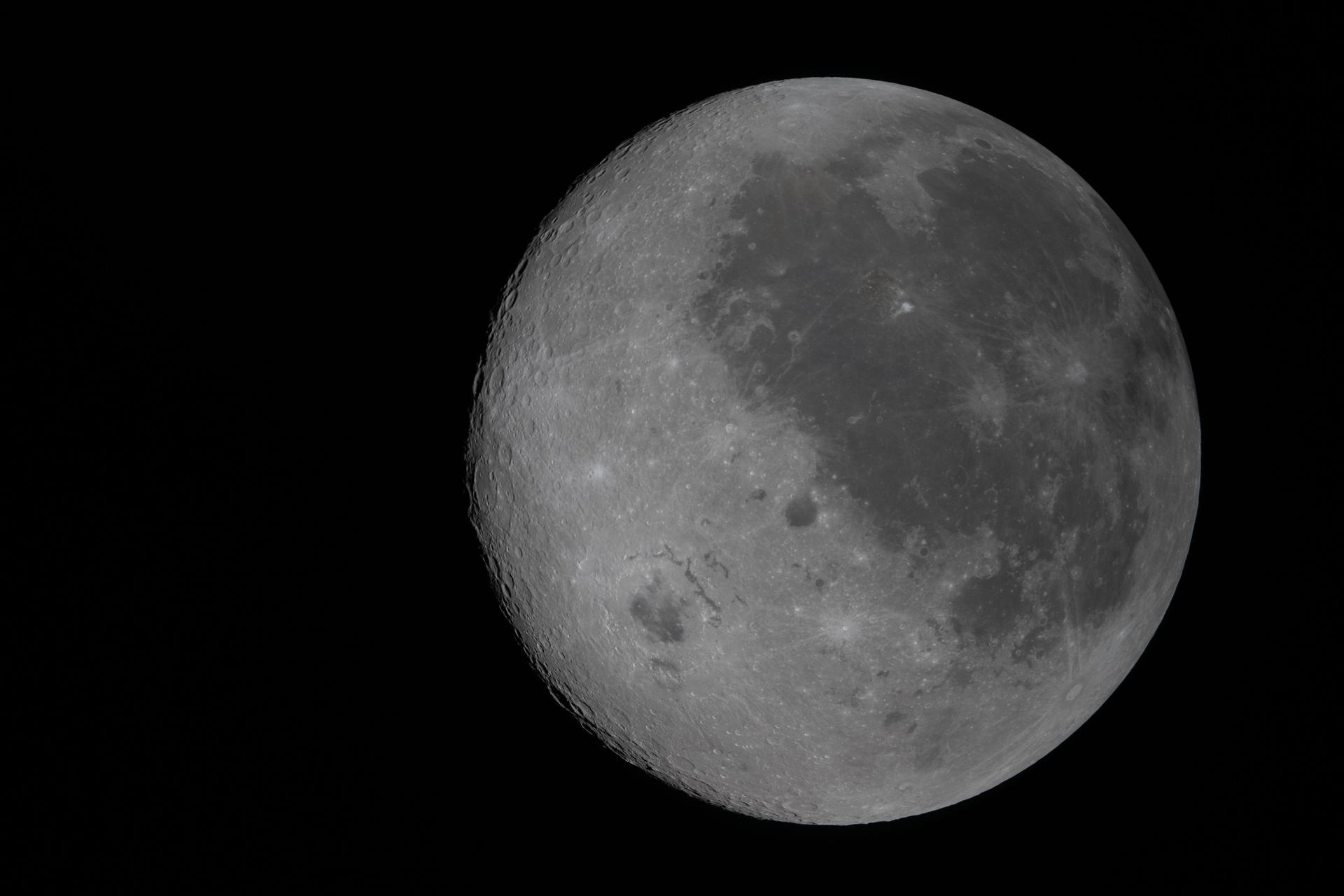
Orientale on Display
art002e009212 (April 6, 2026) In this fully illuminated view of the Moon, the near side (the hemisphere we see from Earth), is visible on the right. It is identifiable by the dark splotches that cover its surface. These are ancient lava flows from a time early in the Moon’s history when it was volcanically active. The large crater west of the lava flows is Orientale basin, a nearly 600-mile-wide crater that straddles the Moon’s near and far sides. Orientale's left half is not visible from Earth, but in this image we have a full view of the crater. Everything to the left of the crater is the far side, the hemisphere we don’t get to see from Earth because the Moon rotates on its axis at the same rate that it orbits round us.
Image Credit: NASA
Source : https://www.nasa.gov/image-detail/amf-art002e009212/
Plus d'info:
https://en.wikipedia.org/wiki/Mare_Orientale
https://science.nasa.gov/moon/lunar-...ientale-basin/
https://science.nasa.gov/moon/lunar-...study-craters/
Dernière modification par GBo ; 06/04/2026 à 22h04.
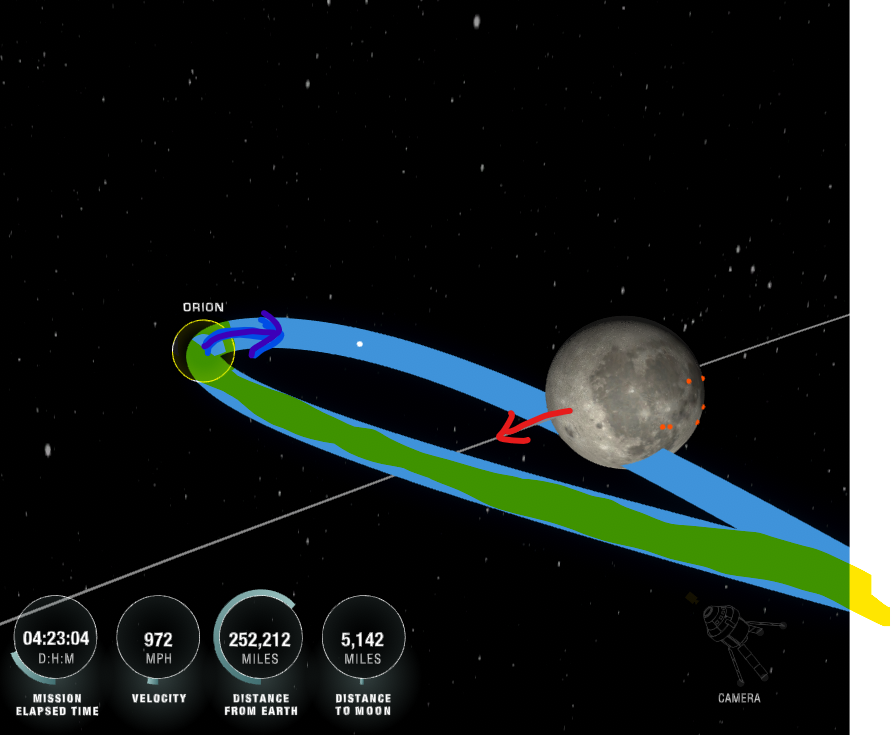
On n'est jamais allé aussi loin de la Terre en mission habitée de toute l'histoire de l'humanité (y compris Apollo donc):
Outil dispo sur : https://www.nasa.gov/missions/artemis-ii/arow/
Dernière modification par GBo ; 06/04/2026 à 22h46.
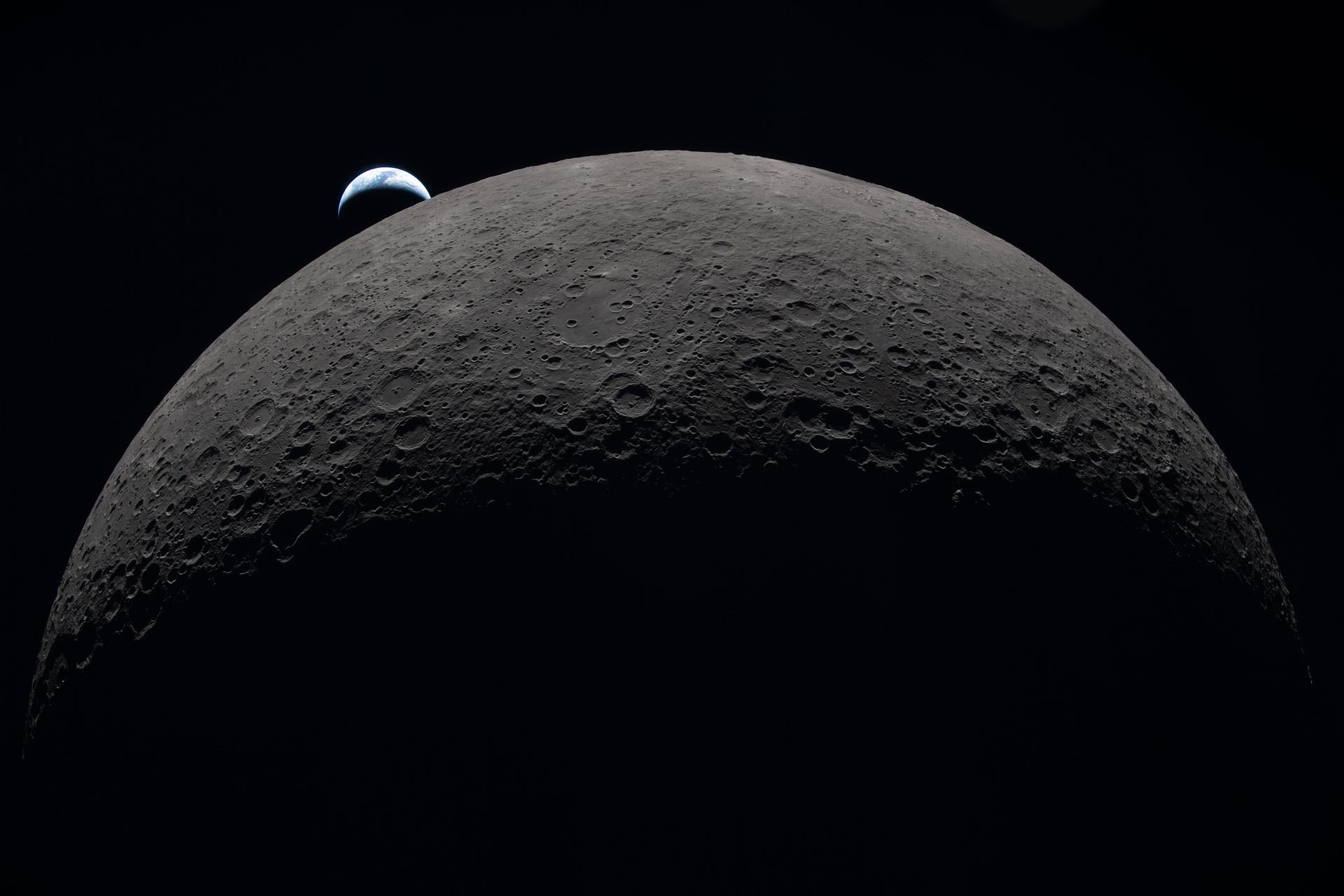
Le vaisseau Orion, la face cachée de la Lune et le croissant de Terre, juste avant la perte de signal:
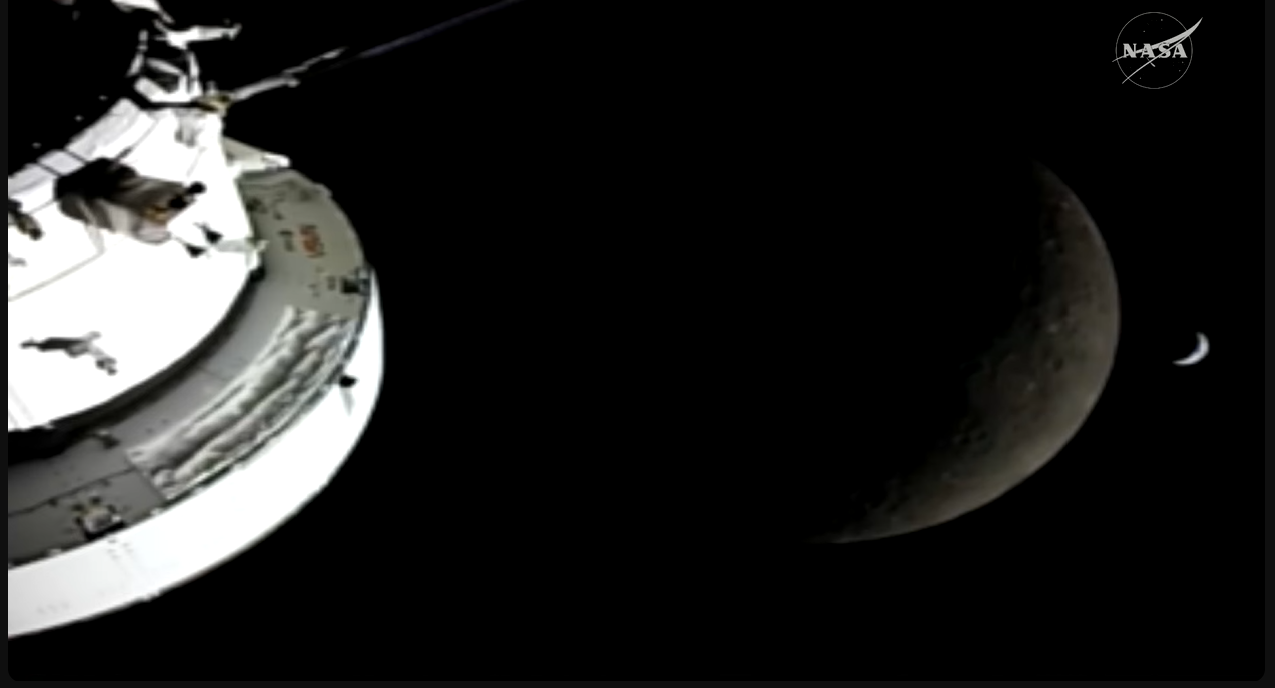
le croissant de Terre est très brillant, le croissant de Lune beaucoup moins. Pourtant c'est la même (grosse) lampe qui les illumine.
Très bonne observation ! C'est presque comme si le régolithe, en terme de réflexion de la lumière (=albedo), était du charbon, comparé au manteau de nuages et d'eau qui entoure la Terre.Envoyé par MissJenny

Avis de Tawahi-Kiwi bienvenu !
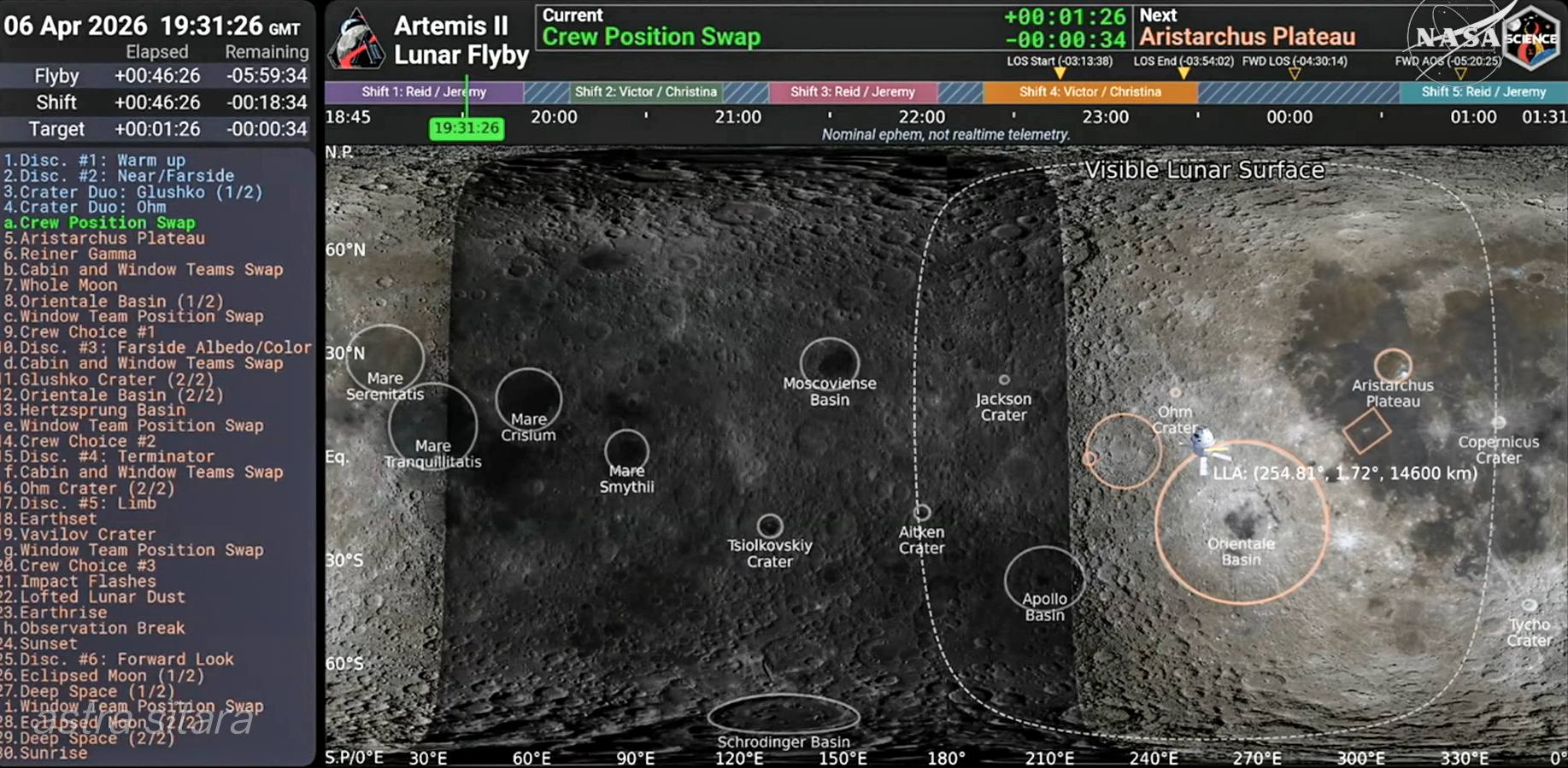
La carte du survol lunaire hier soir lors du premier shift, avec vue imprenable sur Orientale Basin:
Artemis II Lunar Flyby
(le vaisseau est figuré au centre de sa surface visible à ce moment)
Dernière modification par GBo ; 07/04/2026 à 08h06.
Pour la Terre, une partie de la réflexion est liée à l'atmosphère dont la Lune est dépourvue.
A New View of the Moon
art002e009287 (April 6, 2026) – Earth sets at 6:41 p.m. EDT, April 6, 2026, over the Moon’s curved limb in this photo captured by the Artemis II crew during their journey around the far side of the Moon. Orientale basin is perched on the edge of the visible lunar surface. Hertzsprung Basin appears as two subtle concentric rings, which are interrupted by Vavilov, a younger crater superimposed over the older structure. The lines of indentations are secondary crater chains formed by ejecta from the massive impact that created Orientale. The dark portion of Earth is experiencing nighttime. On Earth’s day side, swirling clouds are visible over the Australia and Oceania region.
Image Credit: NASA
Source: https://www.nasa.gov/image-detail/amf-art002e009287/
https://www.nasa.gov/gallery/lunar-flyby/
Petit retour sur la remarque de MissJenny.
Il y a un site wikipédia sur l'albédo des planètes qui explique en partie la différence :
https://fr.wikipedia.org/wiki/Albédo...%20du%20corps.
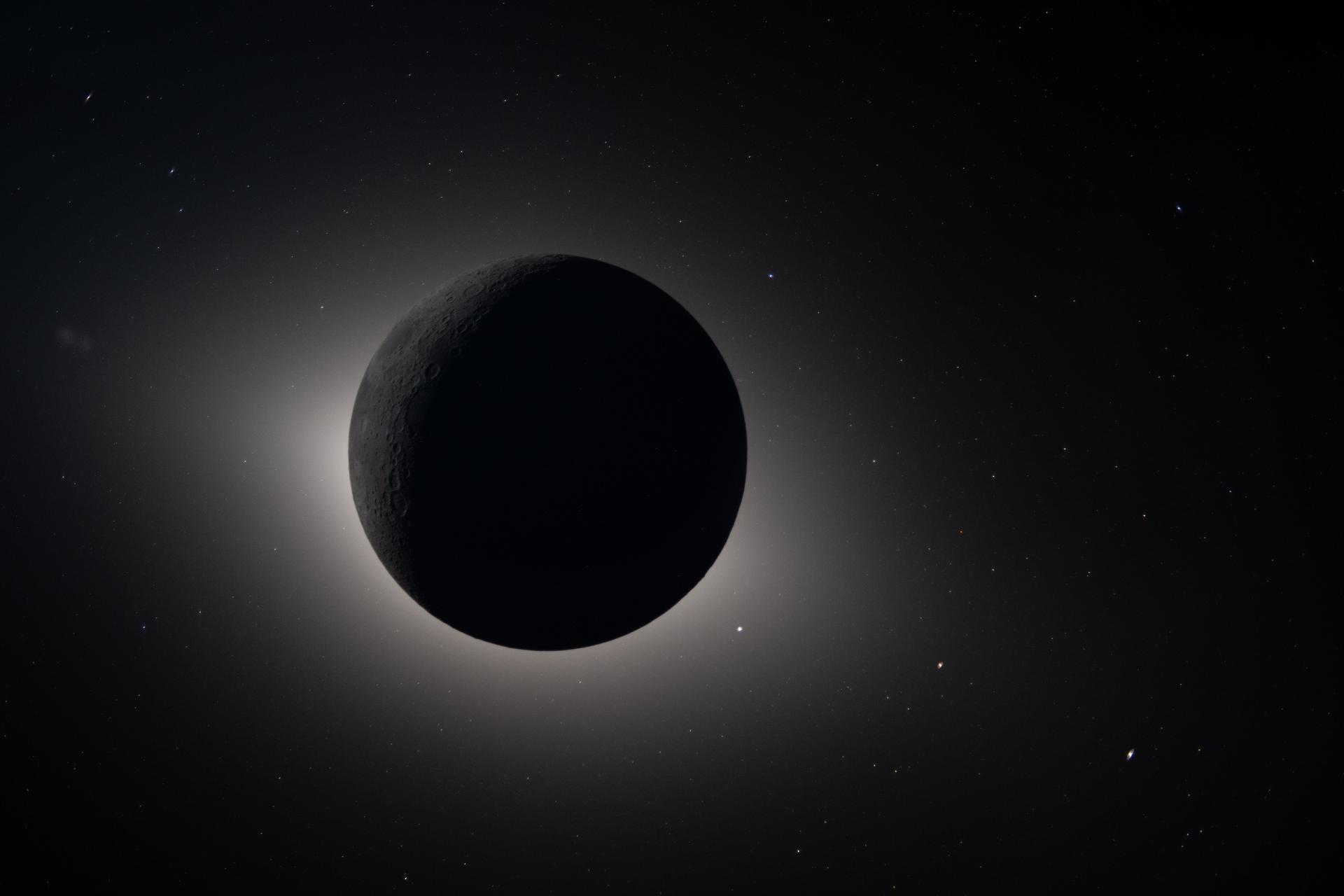
Artemis II in Eclipse
art002e009301 (April 6, 2026) – Captured by the Artemis II crew during their lunar flyby on April 6, 2026, this image shows the Moon fully eclipsing the Sun. From the crew’s perspective, the Moon appears large enough to completely block the Sun, creating nearly 54 minutes of totality and extending the view far beyond what is possible from Earth. The corona forms a glowing halo around the dark lunar disk, revealing details of the Sun’s outer atmosphere typically hidden by its brightness. Also visible are stars, typically too faint to see when imaging the Moon, but with the Moon in darkness stars are readily imaged. This unique vantage point provides both a striking visual and a valuable opportunity for astronauts to document and describe the corona during humanity’s return to deep space. The faint glow of the nearside of the Moon is visible in this image, having been illuminated by light reflected off the Earth.
Image Credit: NASA
Source: https://www.nasa.gov/image-detail/amf-art002e009301/
https://www.nasa.gov/gallery/lunar-flyby/
Par comparaison, l'albédo global de la Terre est similaire a la reflectivité d'une dalle de beton recente ou un désert de sable alors que la reflectivité de la Lune est similaire a des choses plus sombres (foret de coniferes, route agée en asphalte, etc.).
T-K
If you open your mind too much, your brain will fall out (T.Minchin)
Ok merci de la précision T-K, et Gwinver aussi.
Bientôt le retour sur Terre, voici le programme expliqué par le directeur de vol (en anglais):
"NASA’s Artemis II Daily News Conference (April 8, 2026)"
https://youtu.be/8ZFM9ywOpl0?t=751
Les graphiques et des explications écrites se trouvent aussi sur ce billet:
"Artemis II Flight Day 9: Crew Prepares to Come Home"
https://www.nasa.gov/blogs/missions/...-to-come-home/
Dernière modification par GBo ; 09/04/2026 à 18h11.
Le lien si vous voulez suivre le retour d'Artemis II intégralement en différé dans les conditions du direct (commenté en français par l'inusable Stardust):
"ARTEMIS II vers la Lune - RETOUR SUR TERRE en direct commenté FR"
https://youtu.be/3b7qGyH0zW4
Dernière modification par GBo ; 11/04/2026 à 06h41.
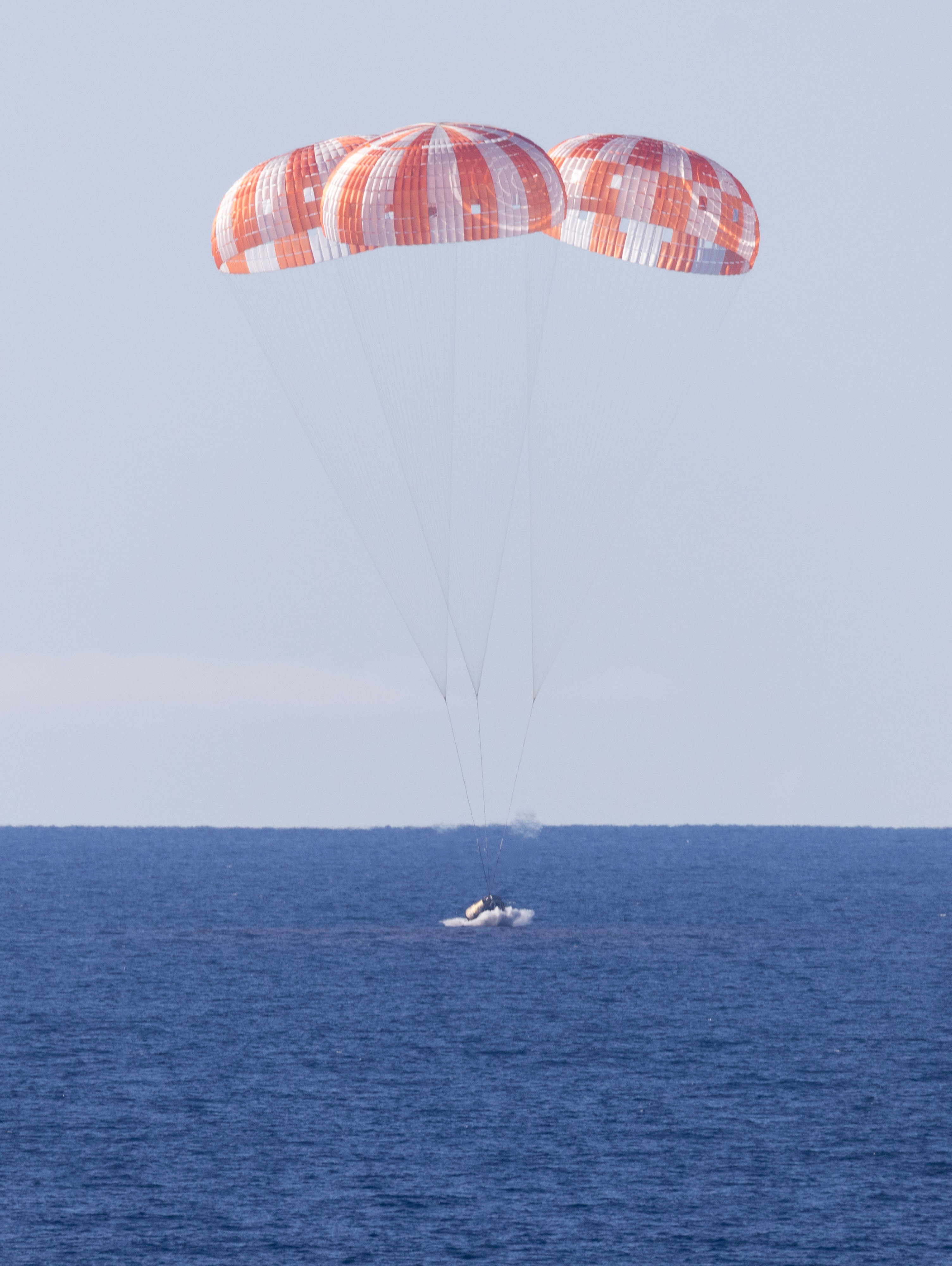
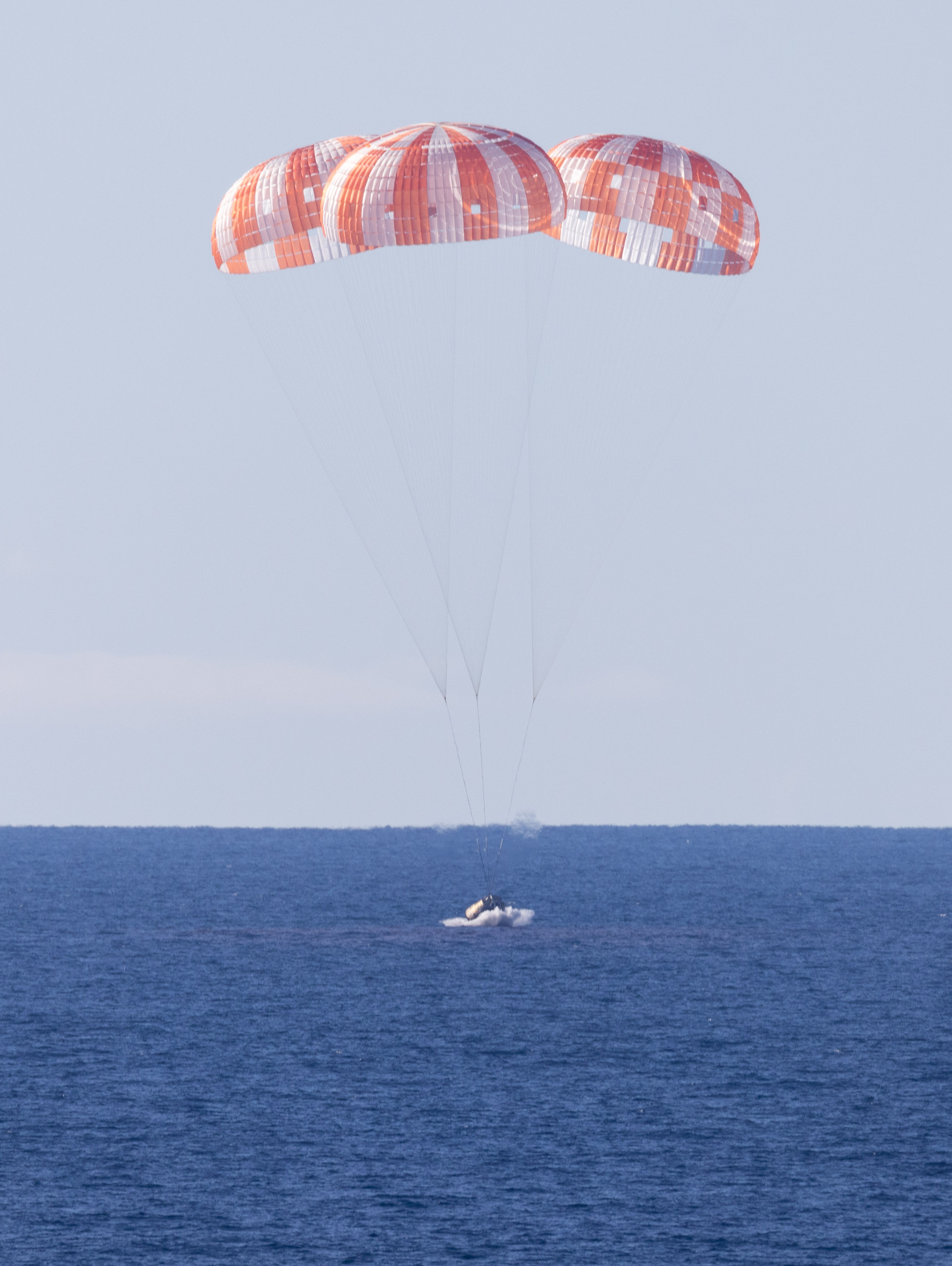
NASA’s Orion spacecraft with Artemis II crewmembers NASA astronauts Reid Wiseman, commander; Victor Glover, pilot; Christina Koch, mission specialist; and CSA (Canadian Space Agency) astronaut Jeremy Hansen, mission specialist aboard was seen as it splashed down at 5:07 p.m. PDT in the Pacific Ocean off the coast of California, Friday, April 10, 2026. NASA’s Artemis II mission took Wiseman, Glover, Koch, and Hansen on a 10-day journey around the Moon and back to Earth.
Credit: NASA/Joel Kowsky
Source : https://www.nasa.gov/news-release/na...back-to-earth/
Bonjour à tous,
Curieux de connaître les vitesses de chutes, voici ce que dit l'IA :
Aperçu IA
Lors du retour sur Terre de la mission Artemis II, le vaisseau Orion utilise une séquence de parachutes pour réduire sa vitesse de rentrée atmosphérique de façon drastique :
Lors de l'ouverture des premiers parachutes (parachutes de freinage/drogue) : À une altitude d'environ 6 700 mètres (22 000 pieds), deux parachutes de freinage (drogues) se déploient pour stabiliser et réduire la vitesse de la capsule à environ 560 km/h (environ 350 mph).
Après l'ouverture des 3 parachutes principaux : Quelques instants plus tard, trois parachutes pilotes déploient les trois grands parachutes principaux. Ils réduisent la vitesse de la capsule pour atteindre une vitesse finale d'amerrissage d'environ 27 à 32 km/h (environ 17-20 mph).
Lire la suite ici :
https://www.google.com/search?client...parachutes+%3F
https://www.google.com/search?client...csuir=1&udm=50
Dernière modification par trebor ; 11/04/2026 à 19h49.
Faire tout pour la paix afin que demain soit meilleur pour tous
C'est plausible.
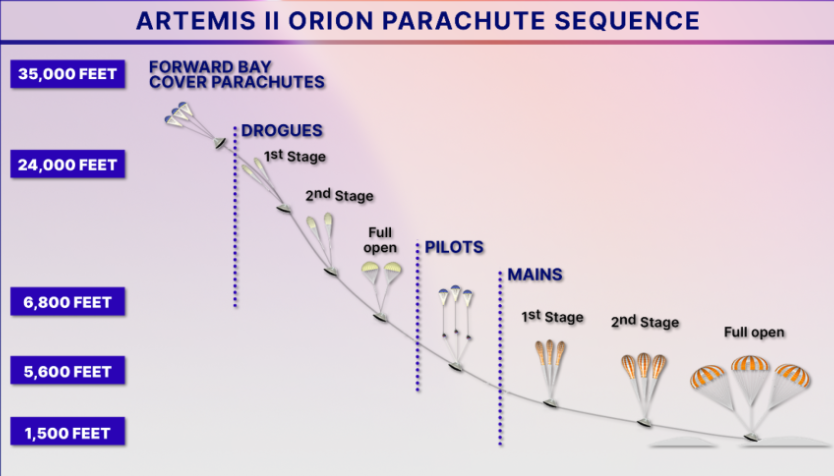
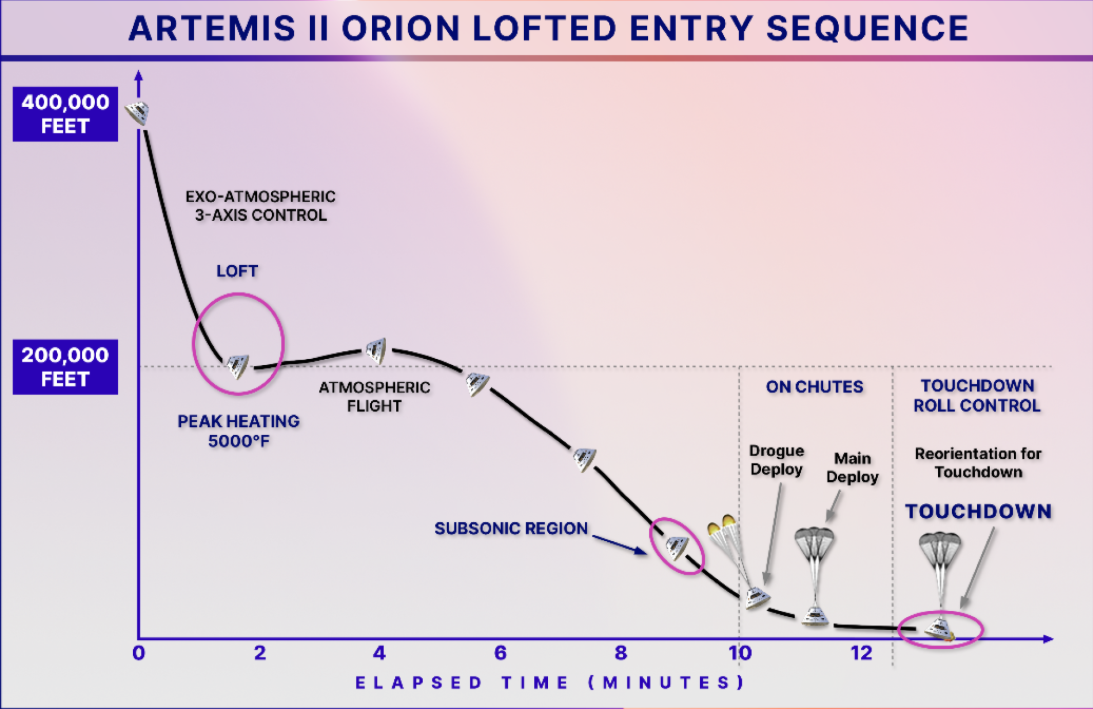
Infographic displaying the Artemis II Orion parachute sequence. This graphic was presented by Artemis II Flight Director Rick Henfling during the mission status briefing to the media and public on April 8, 2026 at NASA’s Johnson Space Center in Houston.
NASA
https://www.nasa.gov/blogs/missions/...-to-come-home/
En tout cas ils ont l'air en forme après 9 jours de voyage
NASA astronaut Victor Glover, Artemis II pilot, left, and NASA astronaut Christina Koch, Artemis II mission specialist are seen sitting on a Navy MH-60 Seahawk from Helicopter Sea Combat Squadron (HSC) 23 on the flight deck of USS John P. Murtha [...]
Image Credit: NASA/Bill Ingalls
https://www.nasa.gov/image-detail/ar...i-recovery-48/
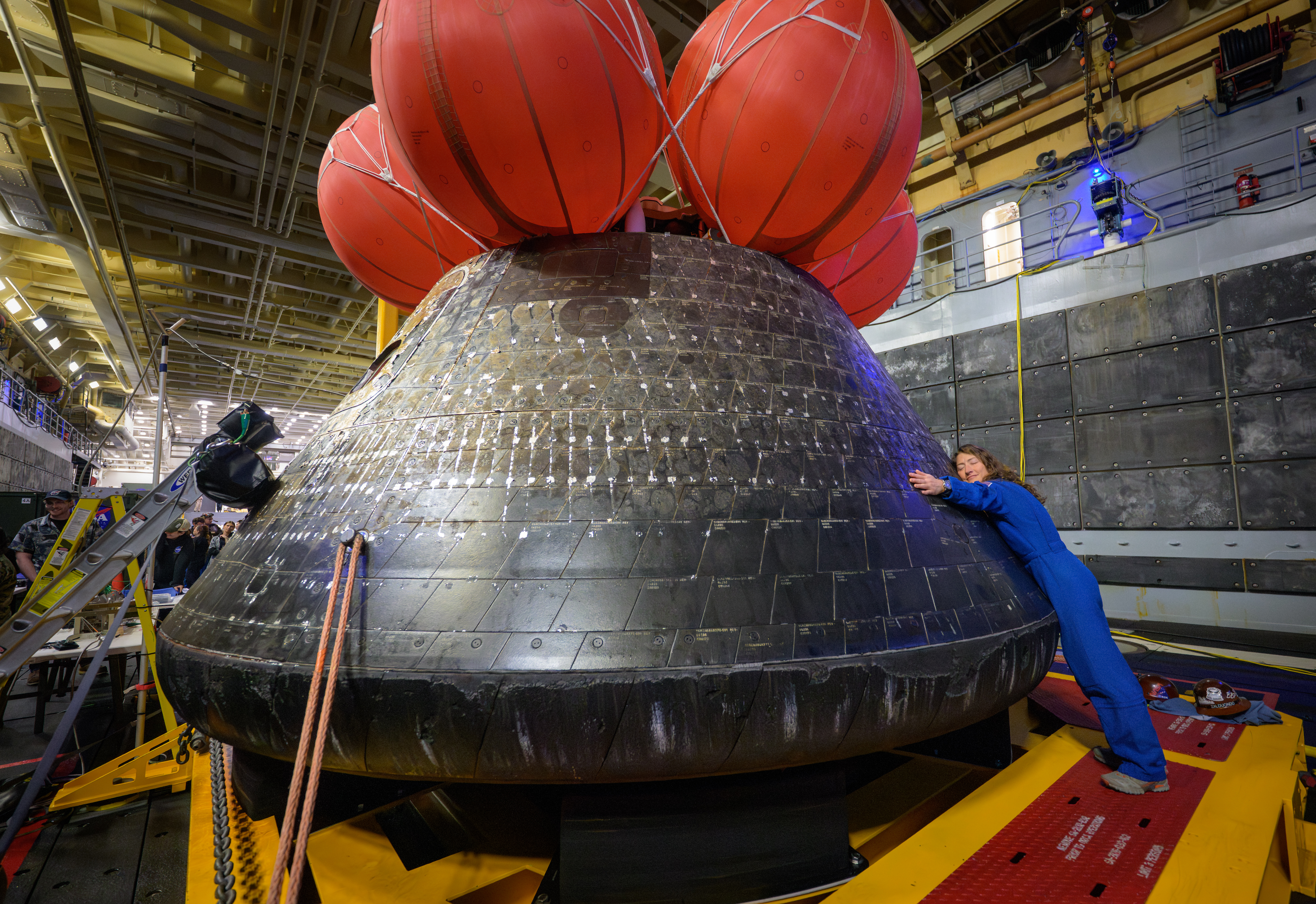
Pour donner une idée de la taille de la capsule Orion (Christina Koch mesure 1,63 m):
NASA astronaut Christina Koch, Artemis II mission specialist hugs the Orion spacecraft in the well deck of USS John P. Murtha, Saturday, April 11, 2026.
NASA/Bill Ingalls
Source: https://www.nasa.gov/image-article/a...way-from-home/
Bjr,
Quick look : https://www.bbc.com/news/videos/clyxxnz97wxo
La suite du programme :
Artemis III:
https://www.nasa.gov/mission/artemis-iii/
Cettyé étape a donc été entièrement repensée suite aux retards - entre autre - de SpaceX sur son module lunaire HLS à base de Starship, pour se contenter de tests en orbite terrestre basse entre Orion et le(s) module(s) lunaire(s) (prévus pour 2027).NASA's Artemis III mission in low Earth orbit will test integrated operations between the Orion spacecraft and one or both commercial landers from SpaceX and Blue Origin respectively.
Artemis IV:
https://www.nasa.gov/mission/artemis-iv/
Le retour des astronautes sur la Lune pour "début 2028" donc, ce qui semble un poil optimiste au niveau date...Artemis IV will be one of the most complex undertakings of engineering and human ingenuity in the history of deep space exploration, exploring the lunar South Pole region. The astronauts’ observations, samples, and data collected will expand our understanding of our solar system and home planet, while inspiring the Artemis Generation.
Dernière modification par GBo ; 15/04/2026 à 07h56.